English
 Français
  Português

What is the ECOWAS Gender Barometer?

The ECOWAS Gender Barometer (EGB) is the Community’s flagship mechanism for measuring, tracking and communicating gender inequalities across the 15 ECOWAS Member States. Developed by the ECOWAS Commission through the Centre for Gender Development (CCDG), the Barometer responds to a long-standing gap: most Member States have made strong legal and policy commitments on gender equality, but comparable, sex-disaggregated data to monitor progress remain scarce and fragmented.
The Barometer:
- Quantifies gender gaps across key dimensions of human development and women’s empowerment.
- Provides a harmonised regional picture, while highlighting differences between countries.
- Supports evidence-based policies and investments to accelerate gender equality and women’s empowerment in line with the ECOWAS Additional Act on Equal Rights between Women and Men and ECOWAS Vision 2050.
The first edition (reference year 2021) sets a regional baseline against which future progress will be measured.
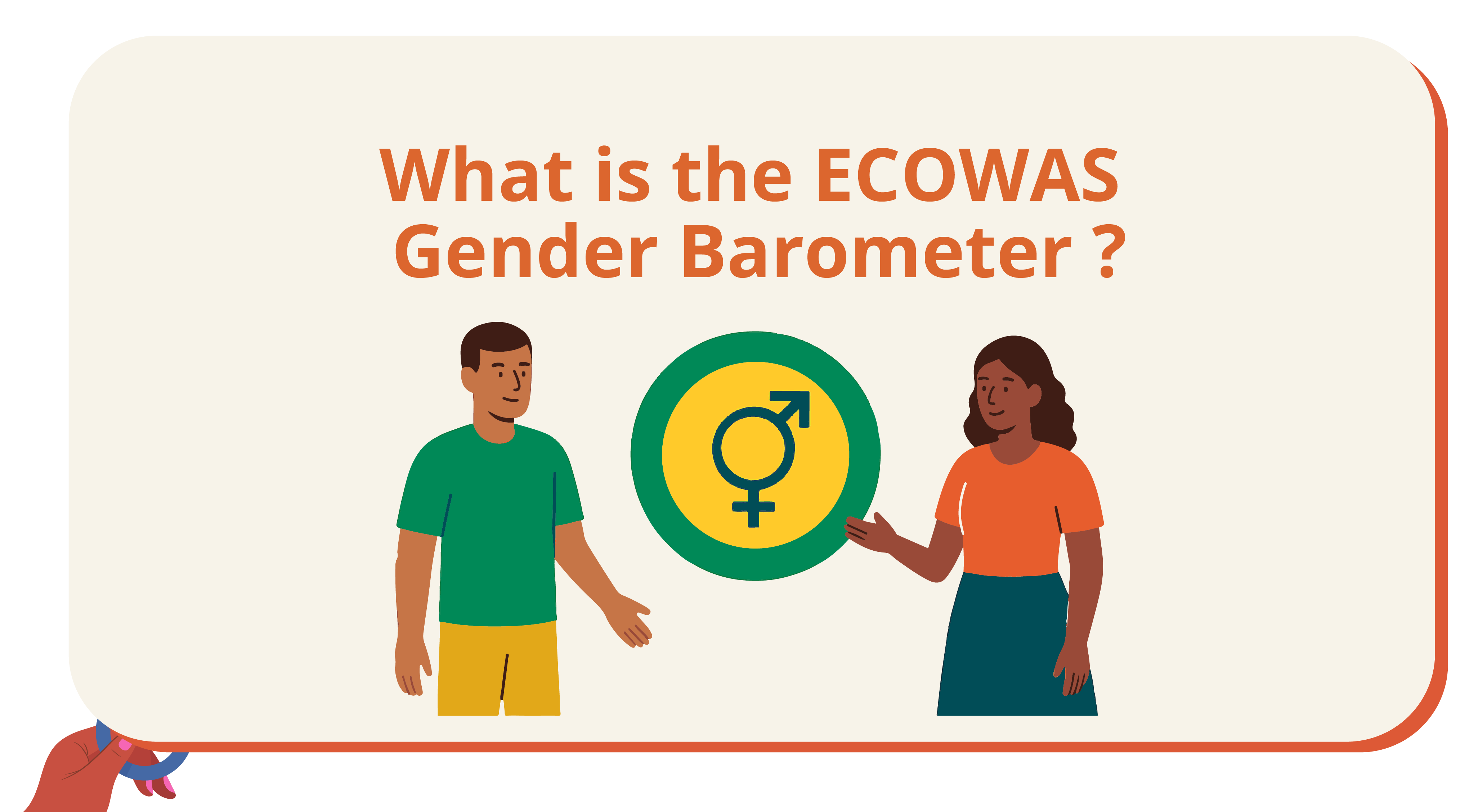
The three components of the Barometer
The ECOWAS Gender Barometer is built around three complementary components:
- Situation analysis of gender inequalities
- A detailed regional and country-level analysis of gender gaps in nine domains, drawing on the latest available data (2017–2021).
- Highlights progress, persistent gaps and promising policy or programme initiatives.
- ECOWAS Gender Equality Index (IEG-CEDEAO)
- A composite index that summarises gender inequalities in six core domains using 38 indicators, with 1 representing parity between women and men.
- Enables easy comparison across countries and over time.
- Digital data and knowledge platform
- An online platform (under development) that will centralise Barometer data, country profiles and technical resources, and make them accessible to policy makers, researchers, civil society, media and development partners.
What does the Barometer measure?
The Barometer’s conceptual framework combines theoretical work on gender equality with ECOWAS policy priorities, especially the Additional Act on Equal Rights and regional gender strategies.
It covers nine domains of gender equality:
- Education
- Health
- Employment and income
- Access to resources and productive assets
- Leadership and decision-making
- Technology (with a focus on digital finance and usage)
- Gender-based violence
- Poverty (monetary and multidimensional)
- Time use and unpaid care work
For the Gender Equality Index, six domains are combined into a single score: education, employment and income, health, access to resources, leadership and decision-making, and technology.
Each domain is broken into sub-dimensions (for example, adult literacy, school completion, quality of jobs, ownership of land and housing, digital payments, political representation, managerial positions), and measured through carefully selected indicators drawn from international and regional data sources (DHS, MICS, ILOSTAT, World Bank, UNAIDS, WHO, UIS, etc.).
How is the ECOWAS Gender Equality Index constructed?
To make the Index robust and transparent, ECOWAS follows a six-step methodology:
- Conceptual framework – define domains and sub-domains aligned with ECOWAS policy frameworks and international standards.
- Data collection and processing – compile 44 gender-relevant indicators for all 15 Member States, address missing data and ensure comparability.
- Indice Egalite de Genre CEDEAO
- Measuring gender gaps – calculate a female-to-male ratio (sex-ratio) for each indicator, with 1 representing parity; values below 1 favour men, values above 1 favour women.
- Indice Egalite de Genre CEDEAO
- Statistical selection of indicators – retain indicators that are robust, relevant and available for most countries.
- Calculating domain scores and global index – aggregate indicator-level scores into six domain scores, then into a single regional index using a geometric mean.
- Choosing the most suitable scenario (IEG-3g) – among several weighting and aggregation scenarios, ECOWAS selected the one that best balances statistical robustness and policy interpretability.
For 2021, the regional Gender Equality Index stands at 0.640, with country scores ranging from 0.584 (Liberia and Benin) to 0.708 (Côte d’Ivoire). This confirms persistent gender inequalities in favour of men across the region.
Key messages from the 2021 baseline
1. Overall picture
At 0.640, the regional index is still far from parity (1.0), with an average gap of 0.36.
Indice Egalité de Genre CEDEAO
Health (0.871) and education (0.854) display the smallest gender gaps and contribute most to the index (23% and 22% respectively).
Employment (0.736), access to resources (0.610), technology (0.583) and especially leadership and decision-making lag significantly behind; leadership contributes only 5% to the overall index.
This means that while girls and women are increasingly in school and surviving longer, they still face major barriers in accessing decent work, economic resources, technology and power.
2. Education – strong progress, but not for all
Education is the domain closest to parity (index 0.85), yet gaps persist, especially in adult literacy and higher education.
Some countries (e.g. Cabo Verde, Ghana, Côte d’Ivoire, Togo) are close to or above parity in most levels of schooling, whereas Sahelian countries such as Niger, Mali and Sierra Leone still face large disparities.
3. Health – near parity, but with pockets of vulnerability
With an average index of 0.871, health shows relatively smaller gender gaps, but there are still important differences between countries and across indicators (maternal mortality, adolescent fertility, HIV incidence, child mortality).
Progress in women’s and girls’ health remains fragile in contexts of conflict, climate shocks and service disruption.
4. Employment & income – persistent inequities in quality and security of work
The employment & income domain (0.736) confirms a structural disadvantage for women in the labour market across the region.
On average, fewer women than men participate in the labour force (56.0% vs 68.8%) and fewer have a job (54.4% vs 67.5%).
Around 5 out of 6 employed women (82.6%) are in vulnerable employment—often informal and insecure; women are also more likely to work part-time and earn on average 11% less per month than men.
5. Access to resources and productive assets – a critical bottleneck
The access to resources domain (0.610) reveals deep structural inequalities in ownership of land and housing and access to formal financial services.
In several countries, women remain largely excluded from property rights and credit, despite legal reforms and targeted programmes.
6. Leadership & decision-making – women’s voices remain under-represented
Women remain under-represented in political and economic decision-making, even though some Member States have adopted parity laws and quotas.
Regional averages mask positive examples (such as higher female representation in cabinets or parliaments in Cabo Verde, Senegal, Togo and Guinea-Bissau), but overall, leadership remains the lowest-scoring domain in the index.
7. Technology & digital finance – growing, but with a gendered digital divide
Between 2017 and 2021, use of digital payments almost doubled in most ECOWAS countries, yet only 23.3% of women used digital payments compared with 35.5% of men.
Women are less likely than men to use a mobile phone or internet to pay bills, shop online or access an account, due to gaps in access to devices, connectivity, digital literacy and affordability.
8. Gender-based violence, poverty and unpaid care – the hidden drivers of inequality
The situation analysis highlights high levels of gender-based violence (GBV), including child marriage, intimate partner violence and harmful practices such as female genital mutilation—exacerbated by conflict and crises. Implementation and enforcement of protective laws remain uneven.
Unpaid care and domestic work is heavily feminised: in several countries, women spend 3 to 8 hours per day on unpaid work—2 to 10 times more than men—and less time in paid work.
As a result, an estimated 32.7% of women of working age are outside the labour force because of family responsibilities, compared to marginal shares of men.
Taken together, these patterns show that gender inequality in ECOWAS is multidimensional, structural, and deeply rooted in social norms, discriminatory institutions and the unequal distribution of unpaid care.
Why gender equality is an economic priority for ECOWAS
The Barometer underlines that gender equality is not only a human right but also smart economics:
- In West Africa, closing gender gaps in labour market participation could raise incomes by 1–30% of GDP, depending on the country.
- Discriminatory laws, norms and practices are estimated to cost West Africa around 120 billion USD each year.
Investing in girls’ and women’s education, health, economic empowerment, leadership and digital inclusion is therefore essential to achieving ECOWAS Vision 2050, inclusive growth and regional stability.
How to use the ECOWAS Gender Barometer page
This page is the gateway to all Barometer resources. It is designed for:
- Policy makers and planners – to integrate gender evidence into national development plans, sector policies, budgets and monitoring frameworks.
- National gender machineries and statistics offices – to support data production, analysis and reporting on gender equality commitments.
- Parliamentarians and local elected officials – to inform legislative and oversight work on gender equality.
- Civil society, women’s organisations and media – to advocate using credible statistics and track accountability.
- Researchers, students and development partners – to deepen analysis, comparative studies and programming.
Download the Barometer publications



AI Chat
Workspace